

By Tami Hiraoka, Fresi Travels | Mongolia, August 17–30, 2026
Mongolia had been on my list for years, and it did not disappoint. Fourteen days across Ulaanbaatar, the far-west Altai, and the Gobi Desert — staying in traditional ger camps, meeting Kazakh eagle hunters, hiking a canyon so narrow that in places only two can walk side by side, and ending most days with stories I’ll be telling for years. This is the journey, the way I lived it.
Ulaanbaatar: A City of Resilience
We began at Gandan Monastery, Mongolia’s most important Buddhist monastery — and the place that first showed me what this country is made of. During the Stalinist purges of the 1930s, most of Mongolia’s monasteries were destroyed or turned into museums, and Buddhism was fiercely suppressed. Gandan survived, kept running as a showpiece for officials. And when democracy arrived in 1990, the faith came roaring back. Standing there among the chanting monks, I felt the weight of that resilience. It set the tone for everything that followed.
On our last day we drove out to the Chinggis Khan Equestrian Statue at Tsonjin Boldog — 40 meters of gleaming steel, the largest equestrian statue in the world, on the spot where legend says Chinggis Khan found a golden whip, an omen of the empire to come. A little history, a lot of horses, and one unforgettable view across the steppe.
We also hiked up to Aryabal Monastery, a steep climb past signboards inscribed with Buddha’s teachings — small moments of reflection built right into the trail — to a monastery tucked above a spectacular green valley. The climb is part of the experience there. Every step earns the view.
The Altai: Three Eagle Camp and the Kazakh Nomads
From Ulaanbaatar we flew west to Bayan-Olgiy, Mongolia’s Kazakh-majority province, and settled into Three Eagle Camp at the foot of Tsambagarav Mountain — a permanent snow-capped peak rising more than 13,700 feet, wrapped by the Altai range. Our home was a traditional ger, and I gave a little video tour: round felt walls, a central stove, and that indescribable coziness that makes you understand immediately why this design has barely changed in a thousand years.
Our first morning, we visited a Uriankhai nomadic family — one of Mongolia’s oldest ethnic groups, descended from the “forest people” of the north. They welcomed us like old friends, showed us their way of life, and then taught us traditional archery. Let me tell you: it is much harder than it looks. There was a lot of laughter, mostly at our expense.
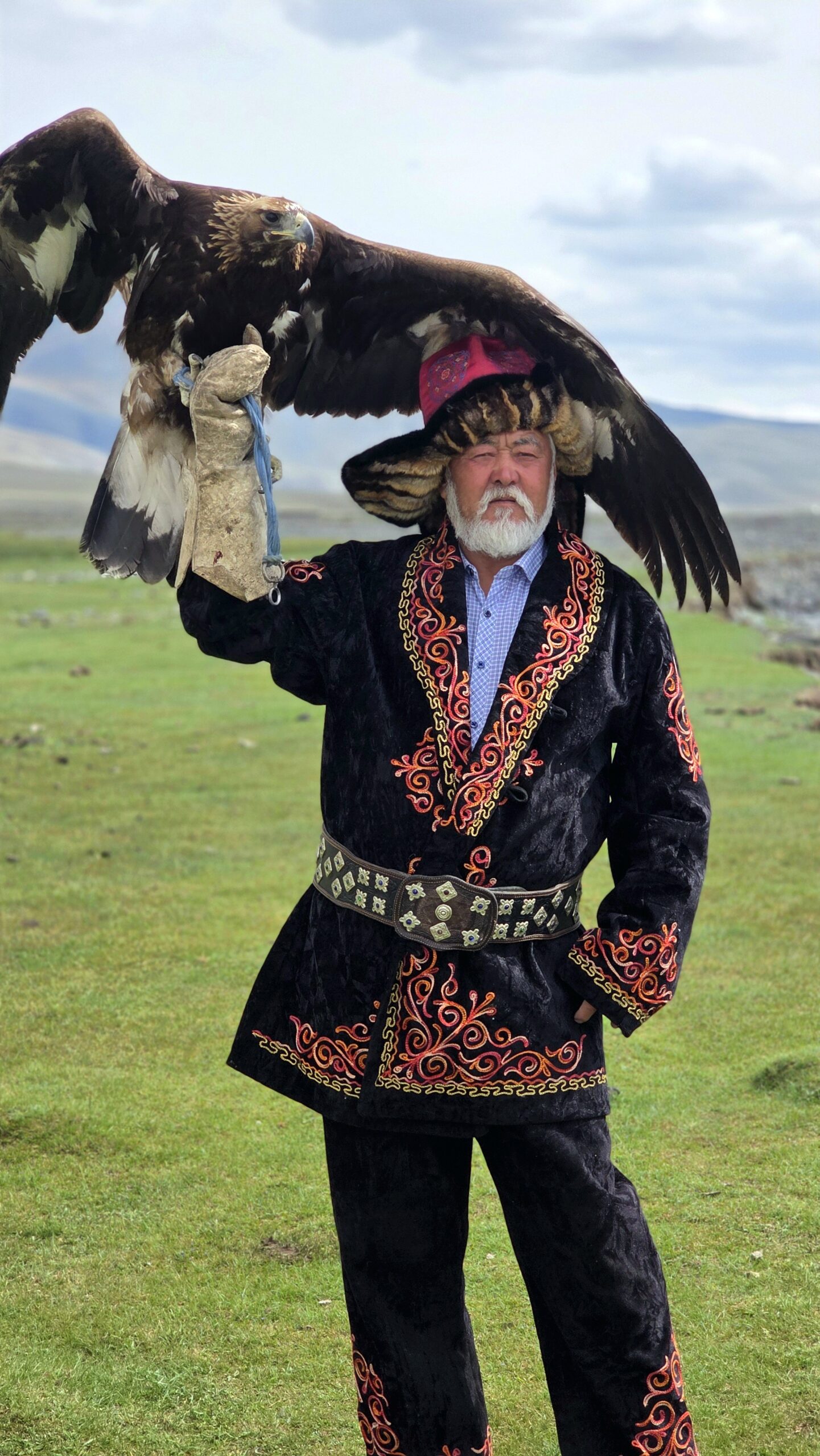
Then came the moment I’ll never forget: meeting a Kazakh eagle hunter. The tradition is called berkutchi — hunting with golden eagles — passed down through semi-nomadic herding families and recognized by UNESCO as part of humanity’s living heritage. Watching a hunter work with his eagle is witnessing a partnership built on years of patience, skill, and trust. Hunting happens in winter, traditionally for fur — fox, hare, wild cats, and the occasional wolf. Holding one of those magnificent birds up close, feeling the weight and the calm intelligence in its eyes — it rearranges something in you. We shared Besbarmak, a traditional Kazakh dish, and soaked in the warmth of Kazakh hospitality.
Another day brought us to a Kazakh family for a display of horsemanship that left us speechless: riders lassoing horses and riding bareback, then Tinge Ilu — galloping at full speed while snatching coins off the ground — plus Kizguar, a playful traditional “courting” chase on horseback. The day ended with a dance performance by the local children, and yes, we joined in. Some of my favorite photos from the whole trip are from that afternoon: dust, laughter, and pure joy.
The Gobi: Three Camel Lodge
Then south to the Gobi Desert and Three Camel Lodge, set against the Gobi-Altai Mountains where the landscape stretches endlessly and the silence feels almost otherworldly. The lodge nails the balance: beautifully crafted gers, brass rain showers, stone-finished bathrooms — the spirit of nomadic life without giving up comfort.
Mornings started at the lodge waterhole, which provides free water to local herders. At sunrise, horses drink quietly at the water’s edge while goats and sheep wander through. And yes — on one of those early mornings, one goat ate my shoelace. A perfect Mongolian morning.
The days filled themselves: we helped build a ger as a demonstration (three people, three hours for a full-size one — this was a smaller kitchen ger), took a sunset camel ride with a local herder family (Mongolian camels have two humps, in case you were wondering), and tasted fresh camel-milk yogurt and milk vodka. We rode horseback across the steppe and found ancient petroglyphs carved into the rock. I spent three full hours in a felt-art class, matting and pressing merino wool into a camel-shaped frame — a genuine workout, and weirdly satisfying. We took an off-road buggy out into absolute nowhere: just us, the wilderness, and curious livestock.
One afternoon I got the ride of a lifetime: Jalsa Urubshurow, the lodge’s founder, drove me around the property in a vintage sidecar. Chasing horses across the steppe while hearing his story — pioneering sustainable travel in Mongolia, his vision for what’s next — was one of those pinch-me moments. He’s an inspiring person and a wonderful partner for what we do.
And then there was Yol Valley, a hidden gem in the Gobi: towering cliffs, a canyon so narrow in places that only two people can walk side by side, a stream running through it — and, if you’re lucky, pikas among the rocks and lammergeiers, the bearded vultures the valley is named for, riding the thermals overhead. Four miles of pure peace. Winter ice can linger there into June — standing in that cool, green corridor in the middle of the desert felt like stepping through a portal.
The Flaming Cliffs were another portal, this one through time. At sunrise and sunset the red sandstone looks like it’s on fire — and in 1923, Roy Chapman Andrews’ expedition found the first dinosaur egg nest ever scientifically recognized right here. Standing among millions of years of history is humbling in the best way.
Our farewell to the Gobi was perfect: a herder family shared their homemade horse-milk vodka, then taught us to milk goats — which ended with milk all over me. I wouldn’t have had it any other way.
Planner’s Notes (from the trip)
- When we went: Mid-to-late August — warm days, cool nights, green steppe. Shoulder seasons bring bigger temperature swings; winter is eagle-hunting season.
- Where we stayed: Three Eagle Camp (Bayan-Olgiy, Altai) and Three Camel Lodge (Gobi Desert) — both traditional ger camps with real comfort.
- Don’t miss: A berkutchi eagle hunter encounter, Yol Valley hike, Flaming Cliffs at sunset, a nomadic family visit, and at least one sunrise at a waterhole.
- Good to know: Domestic flights connect Ulaanbaatar to the regions; overland distances are vast, so build in buffer days. A ger is cozy and warm — don’t let the idea of “camping” fool you at the luxury camps.
- For whom: Adventurous travelers, culture lovers, photographers, and anyone who’s ever wanted to feel deliciously small under a huge sky.
Mongolia is vast, wild, and deeply human — all at once. If it’s calling to you, we’d love to plan it. ✈️🇲🇳
— Tami
Interested in experiencing Mongolia for yourself? Contact @fresitravels and let’s start planning your adventure.